
Criminal Cases in the Lancaster County Courts
Lancaster County criminal cases do not all remain in one court. Lancaster County Court handles misdemeanors, traffic and assigned ordinance matters, along with the preliminary stages of felony prosecutions. The District Court of the Third Judicial District has felony trial jurisdiction. A felony file can therefore show early proceedings in County Court before the prosecution moves to District Court. The Separate Juvenile Court has its own jurisdiction and confidentiality rules, while Nebraska appellate case data uses a different search layer.
The court and case number identify the controlling file. The County Clerk is not the criminal court clerk, even though these offices share the downtown government campus. County Court records questions go to 402-441-7291, and its Criminal and Traffic Court Division uses 402-441-8959. District and juvenile record questions go to 402-441-7328. Asking the correct clerk matters because an arrest report, a jail booking, and a filed Lancaster County court case belong to different custodians.
Lancaster County Criminal Court Jurisdiction
The Lancaster County Attorney reviews reports from Lincoln Police, the Sheriff, Nebraska State Patrol, and other agencies. Its lawyers then decide which charge, if any, to file. The office reports assignments before seven County Court judges and eight District Court judges. That division explains why the arrest charge may not match the filed charge and why a name search can return more than one court file for the same course of events.
The official Lancaster County courts hub shows the local court structure and routes record questions. Its visual overview helps separate County, District, and Separate Juvenile Court before a request is sent.
Use that court split as the first filter. Misdemeanor and preliminary felony entries point to County Court, while a felony judgment belongs in the District Court record.
How to Search Case Records
The Nebraska Judicial Branch case-information service describes three JUSTICE access paths. A one-time party search costs $15, returns no more than 30 records, remains viewable for three days, and does not include document images. Subscriber access costs $100 a year, supports up to ten users, and charges $1 for case detail or a case-number or judgment-date search. Public electronic images are included with subscriber case detail. A courthouse kiosk or designated law-library terminal provides free access to case information.
- Choose the one-time, subscriber, or free courthouse JUSTICE channel based on whether document images and repeated searches are needed.
- Enter the party name accurately, or use a case number when the subscriber tools make that route available.
- Limit results by Lancaster County, criminal case type, court, and year. These filters help when a common name reaches the 30-result cap.
- Open the matching case detail and read each count, disposition, judgment, and register-of-actions entry in context.
- Ask the correct court clerk for a public copy, certified record, or older item that is not available as an image.
| Field Label | Type | Required | Notes |
|---|---|---|---|
| Party name | Text | Primary for one-time search | Use accurate spelling; common names may reach the result cap. |
| Court and county | Filter | Optional | Select County, District, or public Separate Juvenile data and Lancaster County. |
| Case type and year | Filter | Optional | A criminal subtype and filing year can remove unrelated results. |
| Court case number | Text | Alternate | Available through the subscriber detail route. |
| Judgment date | Date | Alternate | A subscriber option when the date is known. |
Search controls vary by access tier. The party-name route is the practical starting point for most remote users, while a case number gives the cleaner match when a prior notice or docket entry supplies it.
Lancaster County Case Search Choices
The lowest-cost route depends on the task. A person checking a few case captions can use a courthouse terminal without the online access fee. A $15 search offers remote convenience but no images and may be a poor fit for a common name. Subscribers can view most public electronically filed documents, yet older paper records and non-imaged items still require the clerk. No online tier opens a sealed record or protected document.
The Lancaster County Attorney formerly offered a local criminal-case search. Its official page now says that feature ended because of legislative changes and directs users to Nebraska.gov. A stale bookmark to the old search is not proof that court data vanished. Move to JUSTICE, then call the clerk when the result list is unclear.
Note: A free courthouse terminal can resolve a broad name search before money is spent on copies or certification.
What the Case File Shows
A Lancaster County case file records the prosecution after charges are filed. Start with the header, parties, offense counts, and disposition. Then use the register of actions as a dated index to complaints, hearings, pleas, motions, orders, judgment, sentencing, and later proceedings. A listed event does not guarantee that its document image is public or available through every access tier. Financial entries also need care because costs and judgments are not, by themselves, a sentence summary.
| Case Number & Court | Identifies the controlling Lancaster County file, court level, case type, filing date, judge, and status. |
|---|---|
| Charging Document | Shows the prosecutor's filed counts, which can differ from allegations listed at booking. |
| Docket Entries | The register of actions lists filed documents, hearings, orders, pleas, and other dated activity. |
| Parties & Counsel | Names the State, defendant, and public attorney appearances where disclosure is allowed. |
| Disposition & Judgment | Records the outcome for each count, such as dismissal, plea, acquittal, or conviction. |
| Sentence & Financials | Shows sentencing activity, costs, judgments assessed or paid, and related orders when entered. |
Public subscriber detail may link most electronically filed documents. The one-time search does not provide those images, and paper or older material may still require staff retrieval.
Reading Lancaster County Case Entries
Read at the count level rather than relying on the word “closed.” An open or closed label describes case administration, not guilt. The final judgment and each count's disposition carry the useful answer. A set-aside order may change the legal effect of a conviction under Nebraska law, but the Lancaster County court file remains visible with that status rather than being erased.
- Arraignment
- The hearing at which the filed charge is stated and a plea is taken.
- Register of actions
- The dated court index of filings, hearings, orders, and decisions.
- Disposition
- The outcome for a charge, which may differ from the overall case status.
- Judgment
- The court's formal decision after a plea, trial, or other resolution.
- Set aside
- Nebraska relief that changes specified effects of a conviction but does not delete the file.
A financial balance should be checked against the judgment and sentence. It can reflect costs or amounts paid and does not define the outcome of every count.
Stages of a Criminal Case
A law-enforcement report reaches the Lancaster County Attorney, who independently decides whether and what to file. A County Court case can begin the felony path with an initial appearance and preliminary proceedings before District Court handles the felony trial. Misdemeanors generally remain in County Court. Pretrial motions, a plea, trial, dismissal, and sentencing appear only when those events occur, so the docket must not be read as a fixed script.
Case flow: Charges Filed › Arraignment › Pretrial › Plea or Trial › Disposition › Sentencing
The sequence also explains why a recent arrest may have no case result yet. Court filing follows agency action, and the filed offense can change after prosecutorial review. For the arrest and booking side of that split, use the contextual Lancaster County arrest history resource.
Lancaster County Case Copy Channels
The District Court Clerk request form asks for contact details, case or party identifiers, case category, email or paper delivery, and certification choice. The office says a reply should come within two business days, but that is a response target rather than a promise that every file will be produced by then. Paper copies are 25 cents per page plus possible postage, and certification begins at $1. Staff contact the requester about cost and payment.
The official Lancaster District Court Clerk page identifies the office that handles felony-level case files and record service.
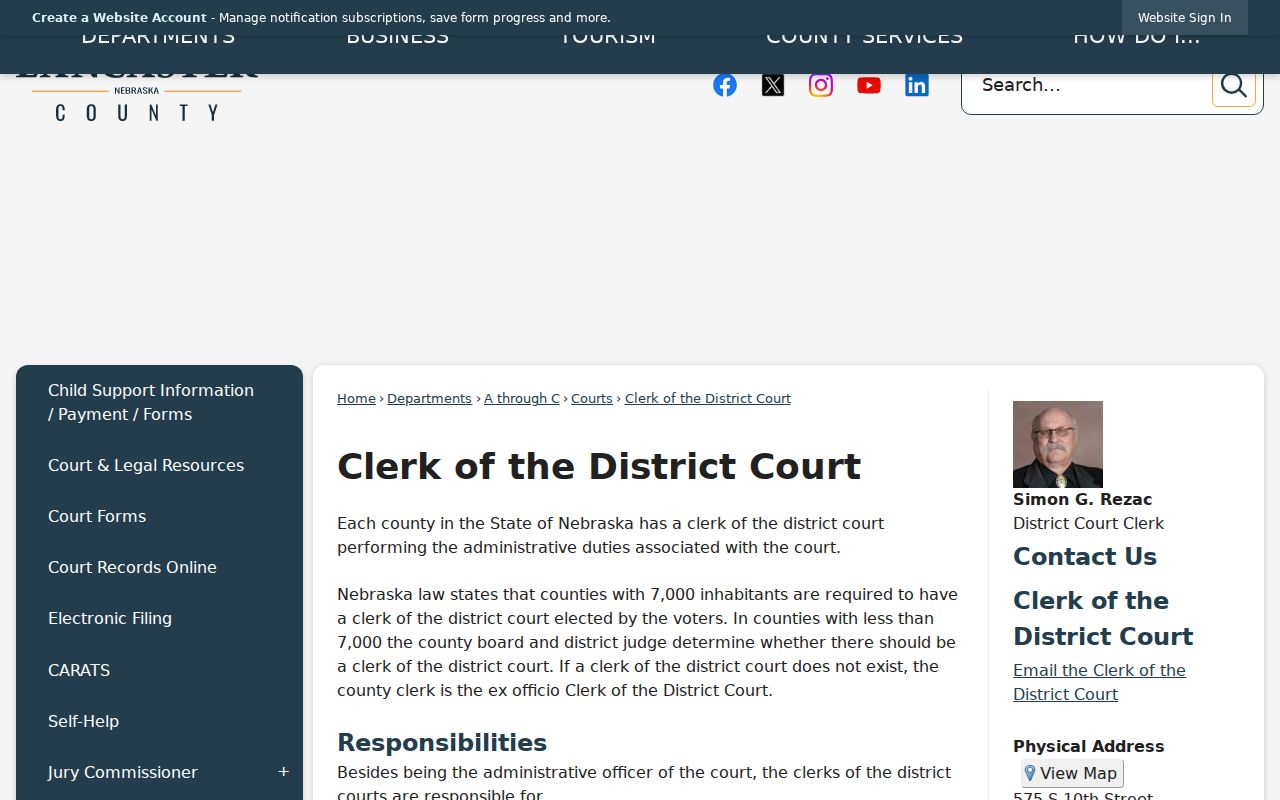
Email-certified copies have extra limits. The researched form restricts them to parties or attorneys and describes one merged, indexed, bookmarked PDF with certification text and page numbering after payment.
Access & Restrictions
Nebraska court records are generally accessible, but public access does not reach every page. Sealed matters, protected personal identifiers, confidential victim details, and nonpublic documents may be withheld or redacted. Most Separate Juvenile Court material is not opened merely because JUSTICE serves other trial courts. A public case shell can exist even when a particular filing cannot be downloaded.
The Nebraska court records search policy governs official access and request routing. If a Lancaster County case does not appear, confirm the spelling, court, year, and case number before contacting the clerk. Ask whether the record is older, stored on paper, sealed, misfiled under a different name, or assigned to another court. The clerk can explain access status but cannot provide legal advice about the meaning of an order.
Lancaster County Juvenile Court Records
Two nearby court layers require separate treatment. Lancaster County's Separate Juvenile Court is not an ordinary public name-search substitute for an adult criminal docket. Confidentiality rules control its records, and public access cannot be assumed from the presence of a court name or case shell. Direct a specific records question to the juvenile office through the District and Juvenile records line.
Appeals also leave the trial-court search path. Nebraska Supreme Court and Court of Appeals data uses the SCCALES subscriber service described by the Judicial Branch. The local JUSTICE file can show that an appeal-related event occurred, while the appellate docket holds the later appellate entries. Federal criminal cases in Lancaster County are separate again and do not enter state JUSTICE solely because the event happened in Lincoln.